Congratulations! The flagship review journal of IAOEES, Electrochemical Energy Reviews, has an IF of 28.905 and Ranks the 65th in the 2021 Journal Citation Reports
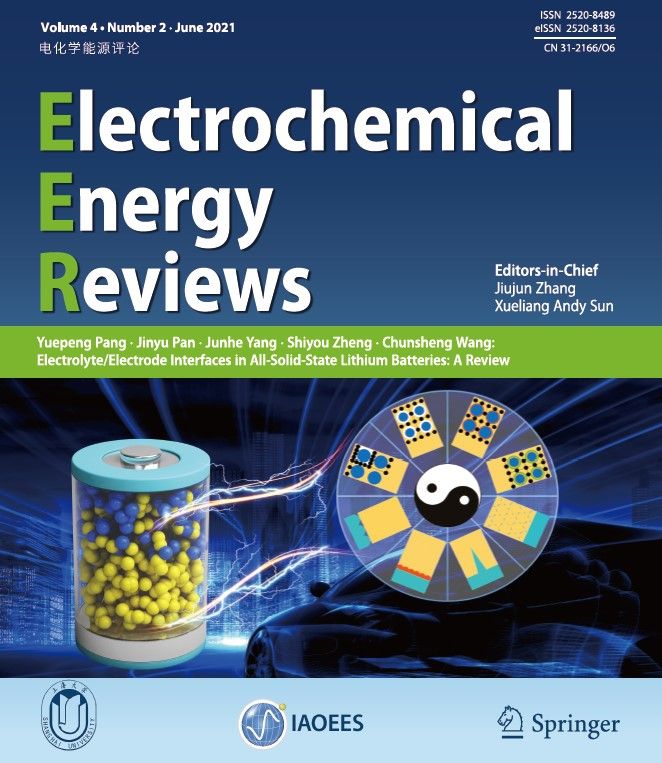
In the 2021 Journal Citation Reports released by Clarivate on June 30, Electrochemical Energy Reviews (EER) has a Journal Impact Factor (IF) of 28.905. This year's edition includes more than 20,000 journals from 113 countries across five continents and 254 research categories in the sciences, social sciences, arts and humanities. EER ranks the 65th of more than 20,000 journals, which is aslo the No.1 ranking among not only the academic journals published in China but also all of the journals in the Advanced Materials for Electrochemical Energy Science and Technology. The ranks of top 100 academic journals in the 2021 Journal Citation Reports is given in the end of this news.
Electrochemical Energy Reviews (EER) is an international journal, administrated by the International Academy of Electrochemical Energy Science (IAOEES) and Shanghai University and published by both Springer Nature and Shanghai University . EER is the flagship review journal of IAOEES, publishing only the high quality scientific review articles at the forefront of Advanced Materials for Electrochemical Energy Science and Technology quarterly. Since its first volume was published in March 2018, 14 issues of 86 high quality review articles have been published, which covered scientific research results in the energy storage, conversion through Electrochemical Energy science and technologies. The articles have been downloaded more than 270,000 times.
The Editorial board of Electrochemical Energy Reviews consists of the internationally renowned scientists and experts in the relevant fields. All of the papers published in EER had been peer-reviewed through a double-blind anonymous review system. Once a paper is published, it can be free downloaded from the Springer website (https://www.springer.com/journal/41918).
The impact factor (IF) or journal impact factor (JIF) of an academic journal is a scientometric index calculated by Clarivate that reflects the yearly average number of citations of articles published in the last two years in a given journal, as indexed by Clarivate's Web of Science. As a journal-level metric, it is frequently used as a proxy for the relative importance of a journal within its field; journals with higher impact factor values are often deemed to be more important, or carry more intrinsic prestige in their respective fields, than those with lower values.
Tips: The papers published in EER after January 1, 2018 are all included in
Science Citation Index Expanded (SCIE)
Journal Citation Reports Science
Current Contents/Physical, Chemical, & Earth Sciences
Sincere thanks go to editorial board, authors, reviewers, and readers for their consistent support for EER. EER will uphold our mission, continuously provide researchers, scholars and practitioners with the best publication services, host an excellent platform for academic communication, and publish only the highest quality scientific review articles. EER welcomes your contribution and submission.
About Us Electrochemical Energy Reviews (EER) aims to present timely the latest scientific research results and state-of-art in the energy storage and conversion through electrochemical energy science and technologies and to motivate and promote the international and multidisciplinary collaborations and communication. EER is the first international English-language review journal that focuses on electrochemical energy, which has two columns, Perspective Revew and General Review. EER covers all the subjects of Electrochemical Energy Science and technologies, including
Fuel cells Batteries Supercapacitors Hydrogen generation and storage CO2 conversion Fundamental electrochemistry Electrochemical nanomaterials Electrochemical energy industry
 Sales
Sales